SQL Certification

Practice on NetflixDB

The Certificate

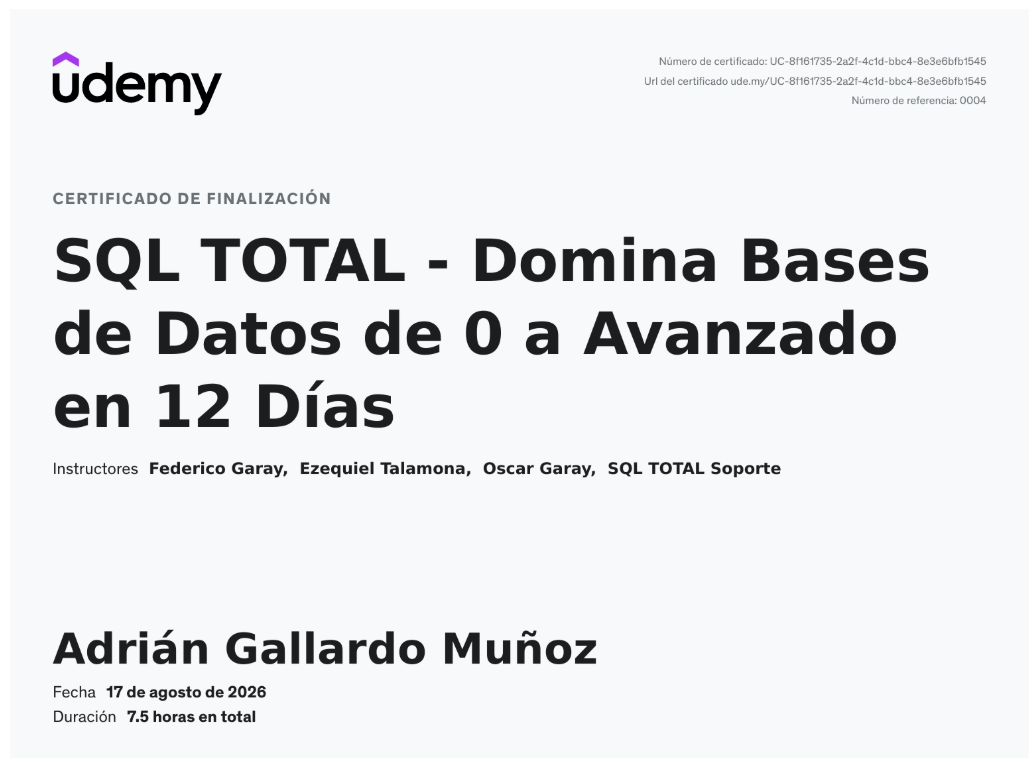
SQL TOTAL — Master Databases from 0 to Advanced (Udemy). Full training in queries, JOINs, aggregations and subqueries.

SQL TOTAL completion certificate (Udemy)

The Database: NetflixDB

Practice relational model: series, their episodes, the actors and their roles.

Actores
actor_idintPK
nombretext
fecha_nacimientodate
Series
serie_idintPK
titulotext
descripciontext
año_lanzamientoint
generotext
Episodios
episodio_idintPK
serie_idintFK
titulotext
duracionint
rating_imdbint
temporadaint
descripciontext
fecha_estrenodate
Actuaciones
actor_idintPK · FK
serie_idintPK · FK
personajetext

PK = primary key · FK = foreign key. Episodios.serie_id references Series; Actuaciones links Actores and Series (composite primary key).

Solved Exercises

Each challenge with its prompt, the SQL query that solves it and a short explanation.

Exercise 1

The most successful series

🎯 Identify the most successful series in NetflixDB, where success is defined by the number of episodes and the average IMDb rating. The result is a table with three columns: series title, number of episodes and average IMDb rating.

JOINCOUNTAVGGROUP BY
SELECT
    s.titulo                       AS titulo_serie,
    COUNT(e.episodio_id)           AS cantidad_episodios,
    ROUND(AVG(e.rating_imdb), 2)   AS rating_promedio_imdb
FROM Series s
JOIN Episodios e ON e.serie_id = s.serie_id
GROUP BY s.serie_id, s.titulo
ORDER BY cantidad_episodios DESC, rating_promedio_imdb DESC;

How it works: I join Series with Episodios on serie_id, group by series and count its episodes while averaging the rating. Ordering by episode count and rating brings the most successful series to the top.

Exercise 2

The 3 most popular genres (with a subquery)

🎯 Use a subquery to identify the three most popular genres (by number of series). For each genre, show the series title, release year and average IMDb rating.

SubqueryINJOINGROUP BYLIMIT
SELECT
    s.genero,
    s.titulo,
    s.año_lanzamiento,
    ROUND(AVG(e.rating_imdb), 2)   AS rating_promedio_imdb
FROM Series s
JOIN Episodios e ON e.serie_id = s.serie_id
WHERE s.genero IN (
    SELECT genero
    FROM Series
    GROUP BY genero
    ORDER BY COUNT(serie_id) DESC
    LIMIT 3
)
GROUP BY s.serie_id, s.genero, s.titulo, s.año_lanzamiento
ORDER BY s.genero, rating_promedio_imdb DESC;

How it works: The WHERE subquery returns the three genres with the most series. The main query keeps only the series in those genres and, joining with Episodios, computes each one’s average rating, showing genre, title and year.

More solved exercises will be added as the practice progresses.