Thesis — Leroy Merlin
Goals and Approach
Goal
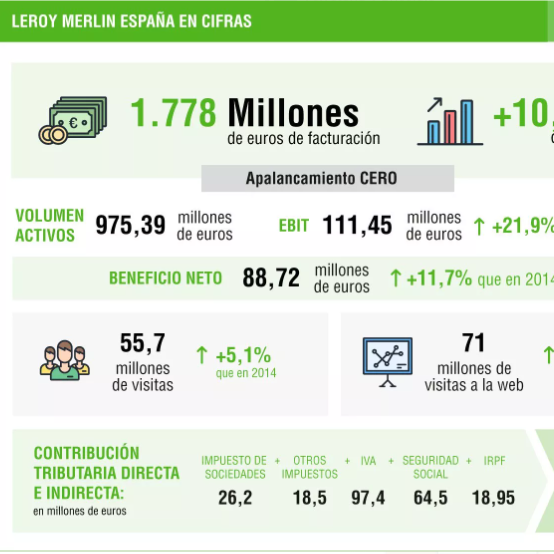
Improve the ratings of Leroy Merlin products versus the competition through data analysis.
Solution
Increase the quality perceived by the customer through tighter control of product logistics and higher quality standards, among other measures.

Technologies
The thesis was built with Excel and the R programming language.
Thesis Presentation
Extract, Transform, Load (ETL)
Data cleaning and preparation in RStudio before the analysis.
Analysis Stages
Variation Analysis
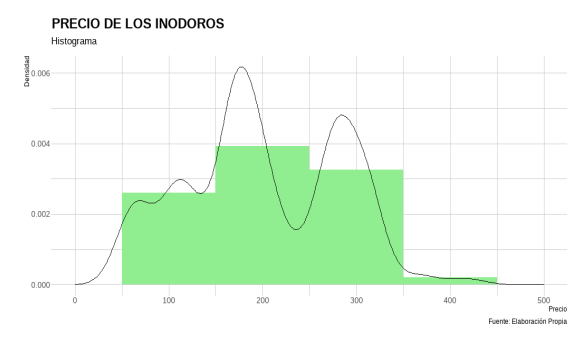
The histogram shows most values concentrated between €150 and €250, with three main product groups. The curve is right-skewed, with a mean of €204.51 and a median of €199.27 — a faithful picture of the market.
Covariation Analysis
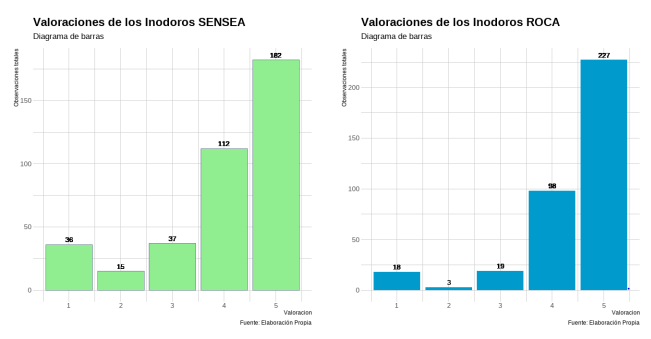
Comparing the Sensea brand with its main competitor, Roca: Sensea receives twice as many negative reviews (ratings 1 to 3), while positive reviews are similar.
The strategy must minimise negative reviews — they weigh most on consumer perception.
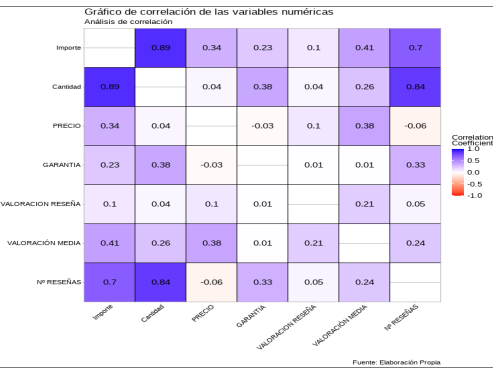
Correlation Analysis
There is a weak positive correlation between average rating and variables such as price, amount and number of reviews. A higher price allows investing in quality, which drives better ratings.
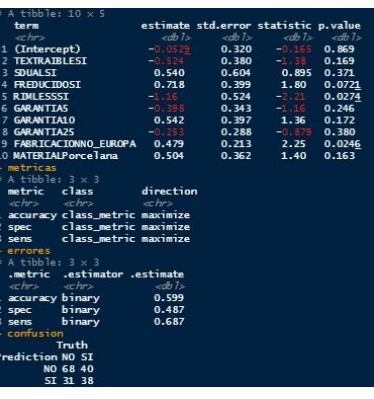
Logistic Regression
Unlike linear regression, the estimators represent changes in the probability of belonging to a category.
Model confusion matrix: 60 true negatives, 40 false positives, 31 false negatives and 38 true positives.
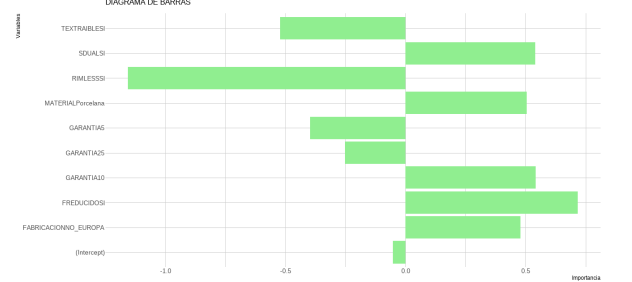
Key Variables to Avoid Complaints
- Manufacturing: Spanish and Portuguese products (like Roca) receive fewer complaints than those made outside Europe.
- Material: ceramic toilets score better than porcelain ones.
- Technical features: the Rimless system and removable lid make cleaning easier.
- Strategy: move from a low-price model towards differentiation through quality.
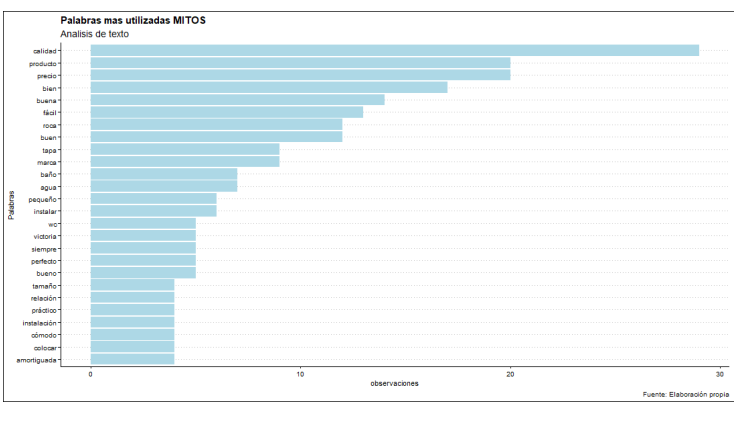
Text Analysis
Word count of the most frequent terms in customer reviews of Roca’s MITOS model.

Word Cloud
The dominant terms in MITOS reviews: price, good, easy, lid...